
Amazon Project Kuiper Satellite Launch 2025: Jeff Bezos’ $10B Plan to Beat Starlink
The race to bring internet from space is heating up, and in 2025, Jeff Bezos is set to take a massive leap with the launch of Amazon’s Project Kuiper. Valued at over $10 billion, this ambitious satellite broadband project aims to rival Elon Musk’s Starlink, reshaping the way the world connects.
What is Amazon Project Kuiper?
Amazon Project Kuiper is a bold plan to launch a constellation of 3,236 Low Earth Orbit (LEO) satellites to deliver high-speed, low-cost internet access to underserved areas worldwide. Approved by the FCC in 2020, the project draws its name from the Kuiper Belt, a region of icy bodies beyond Neptune.
Amazon isn’t just launching satellites—it’s building the entire ecosystem from the ground up. From a massive manufacturing facility in Kirkland, Washington to proprietary user terminals, ground stations, and software, the company is focused on delivering an end-to-end internet experience under its own control.

Key Features of Project Kuiper
- Global Coverage: Internet access in remote villages, oceans, and even conflict zones.
- Low Latency: LEO satellites offer ultra-fast, low-lag connectivity.
- AWS Integration: Deep integration with Amazon Web Services, offering cloud-computing power directly from orbit.
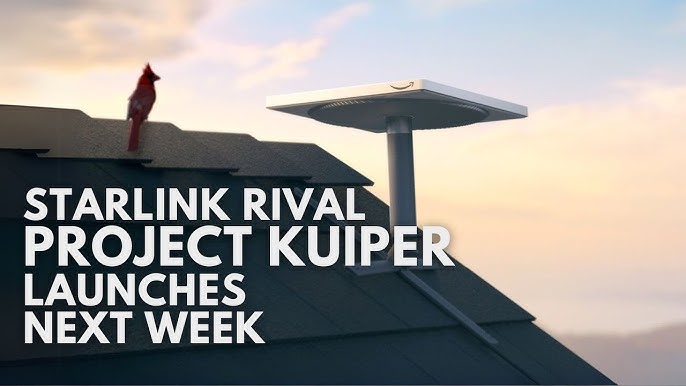
- Customer Terminals: Compact, affordable user terminals designed for easy installation.
- Launch Partnerships: Collaborations with Blue Origin, ULA, Arianespace, and more for satellite deployment.
Project Kuiper vs Starlink 2025
| Feature | Amazon Project Kuiper | SpaceX Starlink |
|---|---|---|
| Satellites Planned | 3,236 | 12,000+ |
| Launch Partner(s) | ULA, Blue Origin, Arianespace | SpaceX (Falcon 9, Starship) |
| Monthly Cost (Est.) | $50 – $75 | $90 – $120 |
| Latency | 20–40 ms | 20–40 ms |
| Speed | Up to 400 Mbps (target) | 50–250 Mbps (current) |
| Cloud Services | AWS Integration | None |
| Availability | Starting late 2025 | Active globally |
Kuiper vs OneWeb vs Telesat
| Feature | Amazon Kuiper | OneWeb | Telesat Lightspeed |
| Satellites Planned | 3,236 | 648 | 298 |
| Orbit Type | Low Earth Orbit | Low Earth Orbit | Medium Earth Orbit |
| Latency | 20–40 ms | ~50 ms | ~50–70 ms |
| Target Market | Global consumer + enterprise | Enterprise, aviation, government | Enterprise, government |
| Backed By | Amazon | Bharti, UK Govt, Eutelsat | Telesat (Canada) |
| Service Rollout | 2025 | Active (Limited) | 2026 (Planned) |
Why 2025 is a Big Year
In 2025, Amazon is expected to launch the first operational satellites of Project Kuiper. With prototype satellites (KuiperSat-1 and 2) already tested, Amazon is preparing for its first full-scale rollout.
- First launch window: Mid-to-late 2025
- Manufacturing center: Kirkland, Washington
- Satellite production goal: Up to 4 satellites per day
Who Will Benefit From Project Kuiper?
- Rural communities with no fiber infrastructure
- Emerging economies with spotty internet coverage
- Businesses needing mobile, cloud-integrated solutions
- Government and military seeking secure, mobile networks
- Disaster recovery teams in remote or damaged areas
Kuiper’s Competitive Edge
Unlike Starlink, Kuiper leans heavily on Amazon’s AWS ecosystem. This allows developers and enterprises to build applications that connect directly with cloud servers in orbit, slashing latency and opening doors to innovations in:
- Remote healthcare
- Smart agriculture
- Logistics and supply chain
- Mobile banking
Satellite Launch Details
-
- Total Launches Planned: Over 80 through 2029
- Launch Vehicles:
- Vulcan Centaur (United Launch Alliance)
- Ariane 6 (Arianespace)
- New Glenn (Blue Origin)
- Primary Launch Sites:
- Cape Canaveral, Florida
- Guiana Space Centre, French Guiana
Challenges and Controversies
- Space debris risk: Thousands of satellites crowding low Earth orbit raise concerns.
- Regulatory hurdles: Global approvals still pending in some countries.
- Competition: Starlink, OneWeb, Telesat, and China’s Guowang Network all racing for dominance.
What about the environment?
Amazon has stated that Project Kuiper will adhere to sustainability best practices in satellite design and deployment. The satellites are designed to de-orbit and burn up in the Earth’s atmosphere at the end of their operational life, reducing long-term space debris. Additionally, Kuiper’s ground infrastructure will utilize energy-efficient technologies, and Amazon claims it is exploring renewable energy sources to power operations — though skeptics are watching closely.
Amazon claims Kuiper is designed with eco-consciousness in mind:
-
Satellites de-orbit and burn up at end of life = no long-term space junk
-
Ground stations will use energy-efficient systems
-
Exploring renewable power sources for satellite production and operations
Critics remain skeptical, but Amazon insists Kuiper won’t be an environmental disaster.
The Bigger Picture: Why Project Kuiper Matters in 2025 and Beyond
Project Kuiper isn’t just another tech project. It represents a pivotal shift in digital infrastructure, offering new possibilities in every aspect of life, including:
- Disaster response networks: Imagine instant internet in disaster zones where terrestrial infrastructure is gone.
- Global education equality: Students in remote or poor regions will finally have the same access as those in big cities.
- Smart logistics: With Kuiper, Amazon could optimize global shipping routes using AI and real-time tracking — even in the middle of oceans or deserts.
- Military and defense: While not officially confirmed, the possibilities of satellite-based communications in modern warfare are enormous.
- Space-based cloud storage: Kuiper’s deep AWS integration might pave the way for cloud computing from orbit, boosting both resilience and reach.
How Will Project Kuiper Impact Developing Economies?
Project Kuiper could be a game-changer for emerging markets. In many developing countries, broadband access remains sparse or prohibitively expensive. Kuiper’s affordable satellite internet could:
-
Bridge the digital divide, bringing millions online for the first time
-
Spur economic development by enabling small businesses to reach global markets
-
Improve healthcare access through telemedicine platforms
-
Expand financial inclusion by supporting mobile banking and microloan platforms
-
Boost job creation in tech, education, and digital services sectors
As governments and NGOs look to modernize rural infrastructure, Kuiper’s rollout may become a key driver of socio-economic transformation across continents.
What Experts Are Saying
Industry analysts and tech leaders are closely watching Amazon’s bold entry into the satellite internet race. Here’s what they’re saying:
-
Morgan Stanley: “Kuiper could become a critical pillar in Amazon’s AWS and e-commerce ecosystems.”
-
MIT Technology Review: “The integration of low-latency satellite broadband with cloud infrastructure is unprecedented.”
-
TechCrunch: “Bezos is betting on Kuiper to do for internet access what AWS did for cloud computing.”
-
IEEE Spectrum: “If successful, Kuiper could rewrite the economics of global connectivity.”
The consensus? Amazon’s Project Kuiper is more than just a broadband solution — it’s a strategic weapon in the digital era.
15 FAQs About Amazon Project Kuiper Satellite Launch 2025
1. What is Amazon Project Kuiper?
Amazon Project Kuiper is a satellite internet initiative aiming to provide global broadband using over 3,200 low-earth orbit satellites.
2. When will Project Kuiper go live?
Initial launches begin in 2025 with beta service expected late that year.
3. How fast is Kuiper internet?
Amazon aims for speeds up to 400 Mbps with latency between 20–40 ms.
4. How much will it cost?
Expected pricing is $50–$75 per month, which is more affordable than competitors like Starlink.
5. Is Kuiper better than Starlink?
It depends — Kuiper is more affordable and integrated with AWS, but Starlink has a head start in deployment.
6. Who can use Kuiper?
Anyone in remote, underserved, or off-grid areas globally.
7. What makes 2025 important for Kuiper?
2025 marks the beginning of large-scale satellite launches and beta rollouts.
8. What devices will I need?
Users will require a compact antenna terminal, which Amazon is designing in-house.
9. Can Kuiper help with emergencies?
Yes — it can provide connectivity for first responders in disaster zones.
10. Is it part of AWS?
Yes, it integrates with Amazon Web Services for real-time data access and cloud computing.
11. Is Amazon Project Kuiper available now?
No, but beta services will begin rolling out in late 2025.
12. How does Kuiper compare to AST SpaceMobile?
AST connects directly to phones, Kuiper requires terminals but offers higher speed and AWS integration.
13. What countries will get access first?
Amazon will likely prioritize the U.S., followed by underserved markets in Latin America, Africa, and Asia.
14. Are there any risks with Kuiper?
Yes — environmental, regulatory, and orbital congestion are major concerns.
15. Why is Amazon investing $10B in this?
To rival Starlink and build the backbone of the future digital economy through global internet access.
The Final Word: Project Kuiper — Internet’s New Frontier
The Amazon Project Kuiper satellite launch 2025 isn’t just a milestone — it’s a statement. A $10 billion moonshot aimed not just at connecting people, but at owning the infrastructure of the internet’s next chapter.
While Starlink currently holds the lead in active satellites and subscribers, Kuiper’s potential to reshape the internet through enterprise-level solutions, real-time edge computing, and AWS cloud dominance is unmatched.
As regulatory approvals fall into place and launch dates approach, one thing is certain:
Jeff Bezos isn’t just going to space — he’s planning to build the future there.
